

Reading Time: ~12 minutes| Series: Database Dialogues
Ember’s Opening:
“Penguins survive in the most challenging environments because their communities are tightly organized. Data models for ministry platforms need that same sense of belonging—and enough adaptability to catch fire when the Spirit moves.” 🐧→🔥
Introduction: Data That Serves, Not Just Stores
When people picture “church tech,” their minds jump to livestreaming, email lists, or maybe a church app showing Sunday’s sermon. But if you peek under the hood of a thriving ministry platform—whether it’s a prayer wall, a volunteer scheduler, or a cross-church SSO system—you’ll find a data model that’s anything but cookie-cutter.
After three years building and scaling Prayer Nook and Heis Soma, I’ve learned that ministry data is uniquely human, relational, and privacy-sensitive. It’s not just “users” and “posts.” It’s people, stories, spiritual journeys, and trust. The right data model can empower connection, compassion, and even transformation. The wrong one? It can lock you into technical and ethical corners that are hard to escape.
Let’s walk through the real lessons (and some scars) from architecting modern ministry data models on Rails 8, with practical takeaways for developers, product owners, and faith-tech dreamers.
1. The Uniqueness of Ministry Data
Ministry platforms are not SaaS clones.
Here’s what makes faith-based data modeling different:
- People wear many hats: A user might be a church member, a group leader, a volunteer, and a prayer requestor—all at once, or at different times.
- Privacy is paramount: Prayer requests, counseling records, and giving histories are deeply personal. Data leaks here are not just technical failures—they’re breaches of trust and pastoral care.
- Relationships > Transactions: It’s about who prays for whom, who’s in what group, and how communities form and dissolve.
- Multi-tenancy is the norm: Even small ministries want to serve multiple congregations, campuses, or partner organizations from a single platform.
2. Fundamental Patterns: Tables, Relationships, and Flexibility
The basics still matter:
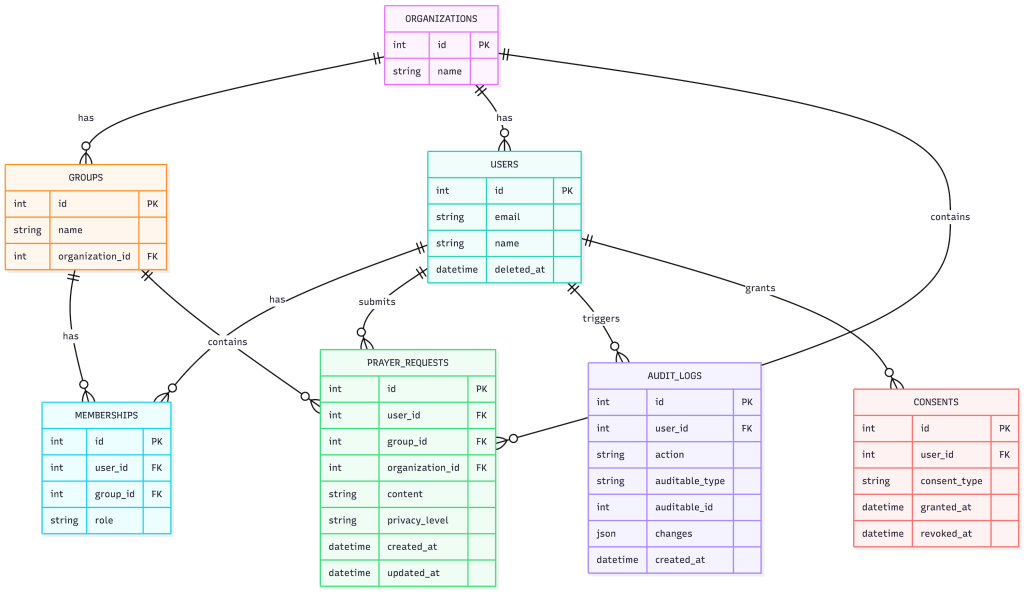
- Users:
- Unique, but can belong to multiple organizations (via join tables).
- Soft-delete instead of hard-delete, for GDPR and pastoral care reasons.
- Roles and permissions managed per-organization, not globally.
- Organizations:
- Churches, small groups, ministries, even parachurch orgs.
- Many-to-many with users, many-to-many with groups, etc.
- Groups:
- Prayer circles, small groups, event teams.
- Flexible membership, with leadership roles.
- Prayer Requests or Events:
- Belong to users, often to groups, sometimes to organizations.
- Require privacy levels (public, group-only, private).
- Audit logs for sensitive data changes.
Key schema lesson:
Default to join tables and polymorphic associations. Ministry platforms evolve fast, and you’ll thank yourself for keeping relationships flexible.
See Code Examples at the end.
3. Multi-Tenancy: Serving Many Masters
Ministry platforms must often support multiple churches or organizations with strong data separation. There are three main approaches:
- Single Table, Scoped by Org:
All data in one schema, every query scoped by organization_id. Simpler but risky—one bug can leak data across orgs. - Row-Level Security (PostgreSQL):
Powerful, but advanced. Policies at the DB level ensure users can only see what they should. Worth considering as you scale. - Schema-per-Tenant:
Each church gets its own schema or even database. Strong isolation, but much higher operational complexity.
Prayer Nook and Heis Soma use the first approach, with strict scoping and read-only models for cross-app access.
Pro-tip: Use Rails’ default_scope (carefully!) and always test for access leaks. Add automated tests to ensure no cross-org data is visible.
4. Privacy, Consent, and Audit Trails
Privacy is a spiritual and legal issue. For every prayer request, profile change, or sensitive note:
- Soft deletes: Use gems like paranoia or acts_as_paranoid.
- Audit logs: Log every change to sensitive data—and who made it.
- Granular privacy: Allow users to set visibility on their own data. “Share with my group” is not the same as “share with the world.”
- Explicit consent: For sharing information beyond the original intent, always ask permission.
In Prayer Nook, every prayer request has a privacy_level and an audit trail. In Heis Soma, sensitive operations (password changes, permission grants) are tracked and require confirmation , .
5. Ministry-Specific Features (And How to Model Them)
- Spiritual Gifts, Roles, and Tags:
Don’t hard-code role names. Model them as join tables or taggings—so churches can define their own structure. - Prayer Matching:
Model “who prayed for whom” as a join table with timestamps and optional notes. This enables analytics like “your request has been prayed for 12 times!” - Hierarchical Groups:
Consider closure tables or self-referential associations if you expect nested groups (e.g., a ministry > small group > team). - Consent to Contact:
Model explicit consent for follow-up, SMS, or email contact. Make this auditable.
6. Rails 8 Patterns: What’s New and What Works
- Multiple Database Connections:
Direct, read-only access to user info from Heis Soma in Prayer Nook cut API calls by 70% and sped up page loads by 27%—but only because we enforced read-only at the DB and Rails level , . - Asynchronous Queries:
Use.load_asyncto speed up dashboards and reports without blocking requests. - Solid Queue for Background Jobs:
Move heavy analytics or notifications to background jobs, keeping the main app responsive.
7. Migration and Future-Proofing
Data models in ministry platforms must adapt to new needs: new privacy laws, new types of spiritual engagement, new reporting requirements. The best way to future-proof?
- Write migrations with reversibility in mind.
- Favor additive changes (new tables, columns) over destructive ones.
- Document every schema decision with comments and architecture docs.
- Write data migrations idempotently—so you can rerun them safely.
8. Case Study: The Evolution of Prayer Nook’s Data Model
When Prayer Nook launched, its data model looked like a “simple” social network. Six months later, it had grown:
- Support for prayer request privacy levels (public/group/private)
- Audit logs for every request
- Per-user notification preferences (modeled as a join table)
- Organization and group structures (via polymorphic associations)
- Consent models for data sharing and follow-up
- Read-only user profiles via cross-database connections
Every change was driven by real ministry needs—not “what Rails makes easy” but “what serves people best.”
9. What I’d Do Differently (And What I’d Do Again)
If I could start over:
- I’d model organizations, groups, and memberships as join tables from day one.
- I’d invest in automated access control tests to catch privacy leaks early.
- I’d include audit logs and consent models up front, not as afterthoughts.
What I’d do again:
- Use Rails conventions (ActiveRecord, polymorphic associations, soft deletes)
- Enforce read-only at both the app and DB level for cross-app access
- Document the why behind every schema decision
Conclusion: Build for People, Not Just Data
At the end of the day, ministry platforms exist to serve people—to foster connection, trust, and transformation. Data models are the invisible backbone of that work. Get them right, and your platform can support real spiritual journeys (and survive three major Rails upgrades). Get them wrong, and you’ll be trapped in technical debt—or worse, break trust with the very people you hope to serve.
My advice: Build for flexibility, privacy, and relationship. Let your data model reflect the heart of your ministry.
Further Reading
- Rails 7/8 Multiple Database Connections in Production
- Zero-Downtime Migrations in Rails 8
- AI Content Moderation for Prayer Requests
Ember’s Closing Wisdom:
“A great data model is like a well-organized colony: every role matters, every boundary is respected, and there’s always room to grow when the winds of change turn cold—or hot.” 🐧→🔥
Code Snippets
1. The various code snippets below correspond with the Mermaid Diagram (generated into visual form) above.
2. Rails 8 Model & Migration Code Samples
User, Organization, Group, Membership
User Model
class User < ApplicationRecord
  acts_as_paranoid # Soft delete
  has_many :memberships
  has_many :groups, through: :memberships
  has_many :prayer_requests
  has_many :consents
  has_many :audit_logs
  belongs_to :organization, optional: true

  # Roles per org
  def role_for(org)
    memberships.find_by(organization: org)&.role
  end
end
Organization Model
class Organization < ApplicationRecord
  has_many :groups
  has_many :users
  has_many :prayer_requests
end
Group + Memberships
class Group < ApplicationRecord
  belongs_to :organization
  has_many :memberships
  has_many :users, through: :memberships
  has_many :prayer_requests
end

class Membership < ApplicationRecord
  belongs_to :user
  belongs_to :group
  # role: string (e.g., leader/member)
end
Prayer Request
class PrayerRequest < ApplicationRecord
  belongs_to :user
  belongs_to :group, optional: true
  belongs_to :organization
  enum privacy_level: { public: 0, group_only: 1, private: 2 }
  has_many :audit_logs, as: :auditable
end
Sample Migration for Prayer Requests
class CreatePrayerRequests < ActiveRecord::Migration[8.0]
  def change
    create_table :prayer_requests do |t|
      t.references :user, null: false, foreign_key: true
      t.references :group, foreign_key: true
      t.references :organization, null: false, foreign_key: true
      t.text :content, null: false
      t.integer :privacy_level, default: 0
      t.datetime :deleted_at
      t.timestamps
    end
    add_index :prayer_requests, :deleted_at
  end
end
3. Join Table for Prayer Tracking
Track “who prayed for whom”:
class CreatePrayers < ActiveRecord::Migration[8.0]
  def change
    create_table :prayers do |t|
      t.references :user, null: false, foreign_key: true      # who prayed
      t.references :prayer_request, null: false, foreign_key: true
      t.text :note
      t.timestamps
    end
    add_index :prayers, [:user_id, :prayer_request_id], unique: true
  end
end

class Prayer < ApplicationRecord
  belongs_to :user
  belongs_to :prayer_request
end
4. Multi-Tenancy & Privacy Patterns
Scoping Data by Organization:
# Always scope queries by current organization
def current_org_prayer_requests
  current_organization.prayer_requests.where(privacy_level: [:public, :group_only])
end
Soft Deletes for GDPR:
# Gem: paranoia or acts_as_paranoid
class User < ApplicationRecord
  acts_as_paranoid
end
5. Audit Log & Consent Example
Audit Log
class AuditLog < ApplicationRecord
  belongs_to :user
  belongs_to :auditable, polymorphic: true
end

# Usage
AuditLog.create!(
  user: current_user,
  auditable: @prayer_request,
  action: "update",
  changes: @prayer_request.saved_changes
)
Consent Model
class Consent < ApplicationRecord
  belongs_to :user
  enum consent_type: { contact: 0, sharing: 1 }
  validates :granted_at, presence: true
end

# When user gives consent
user.consents.create(consent_type: :contact, granted_at: Time.current)


0 Comments